The Different FIRE Paths
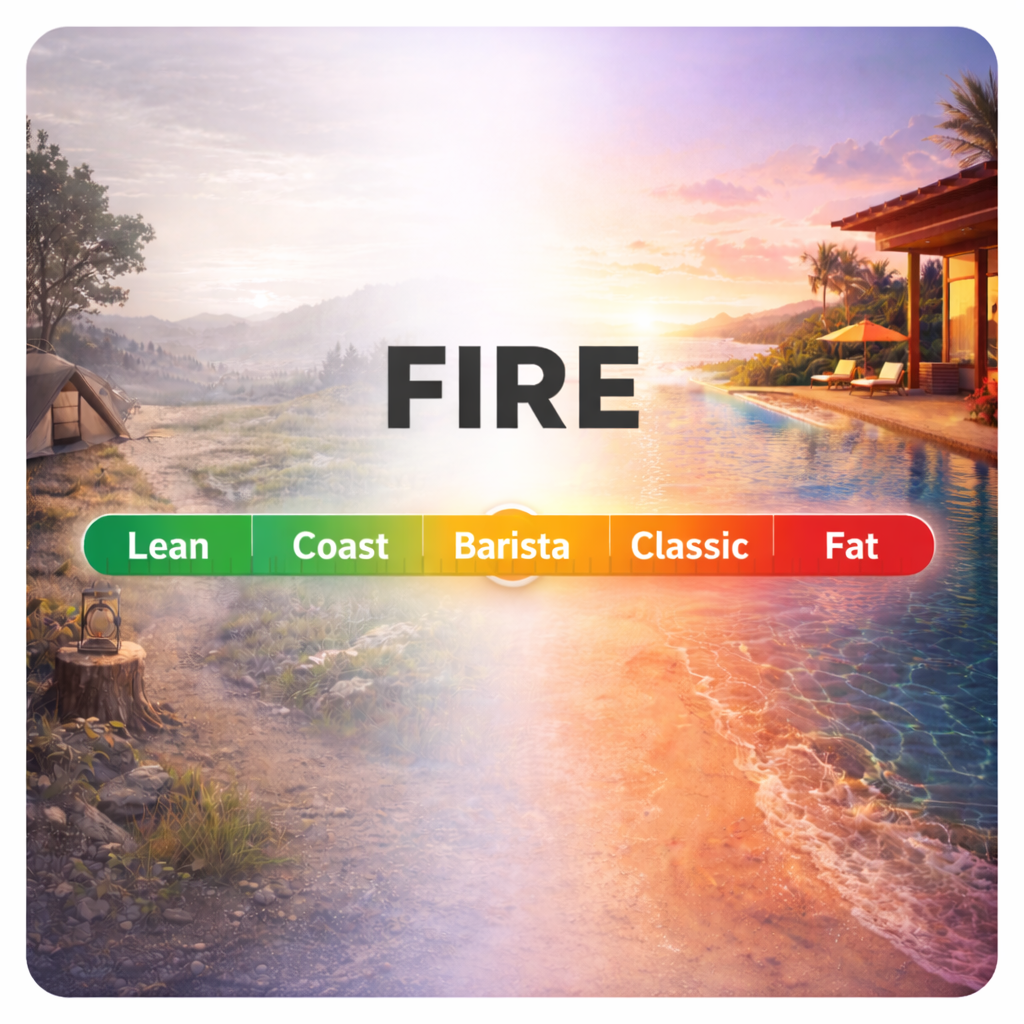
Classic FIRE – the traditional path to full financial independence
When someone first encounters the concept of FIRE, Classic FIRE is almost always the image that comes to mind. A state where money no longer makes decisions for you, where you do not need to work in order to live, and where you once again have control over your time. This is the original, “textbook” version of FIRE: complete financial independence without the need for active work.
Classic FIRE is not a quick fix, not a trick, and not an extreme lifestyle. It is a long-term strategy that requires consistency, patience, and rational decision-making. In return, it provides stability — not only financially, but mentally as well.
What does Classic FIRE mean in practice?
At its core, Classic FIRE is simple: you build an invested portfolio large enough that its returns can sustainably cover your annual living expenses. The emphasis is on the word sustainably. Not for one or two good years, but for decades — potentially for an entire lifetime.
This is why the so-called 4% rule became widely known. According to this rule, you can withdraw roughly 4% of your portfolio each year without a high risk of running out of money. From this comes the familiar multiplier: you need roughly twenty-five times your annual expenses invested.
If you want to live on 400,000 forints per month today, that equals 4.8 million forints per year. Twenty-five times that is approximately 120 million forints. This is neither an unattainable luxury sum nor a trivial amount. That is exactly why Classic FIRE is better viewed as a long-term project rather than a quick goal.
How long does it take to reach?
Classic FIRE takes time, but it is not necessarily slow. The decisive factor is not how much you earn, but what percentage of your income you can consistently invest. A 20–30% savings rate already produces meaningful results, while rates above 40–50% accelerate progress dramatically.
Many people reach their goal in 15–20 years if they build steadily and markets behave “normally.” Others plan for 20–25 years, which is entirely realistic, especially if major life events such as starting a family, buying a home, or other large commitments occur along the way.
One important characteristic of Classic FIRE is that it does not require extreme deprivation. It is not about denying yourself for decades, but about consciously deciding what is worth spending money on — and what is not.
Where is this approach strong?
The greatest strength of Classic FIRE is predictability. It is easy to model, easy to plan, and does not require constant reinvention. Once the system is in place — regular investing, a diversified portfolio, disciplined spending — it largely runs on its own over the long term.
This approach is particularly appealing to those who do not want to start businesses, build multiple income streams, or constantly optimize their finances. Classic FIRE does not try to “outsmart the market.” It accepts that the global economy grows over time and aims to participate in that growth.
It is also a mentally strong model. You know your number, you know your goal, and every invested unit of currency brings you closer. There are no vague promises — just slow, steady progress.
Where are the weaknesses?
Ironically, its conservatism is what discourages many people. Classic FIRE requires a relatively high target portfolio, and it takes time before the results truly feel tangible. The early years can be frustrating, because you invest significant effort while progress still feels abstract.
It is also sensitive to life changes. Having children, relocating, or experiencing a prolonged income reduction can easily disrupt the original plan. In such cases, many people adjust their path and switch to a more flexible FIRE variant — which is not failure, but adaptation.
Another challenge is psychological. Accepting that freedom may still be 15–20 years away can be difficult, especially when other FIRE approaches promise faster results.
What kind of portfolio fits Classic FIRE?
The Classic FIRE portfolio is intentionally boring. Not because more exciting options do not exist, but because stability and cost efficiency matter most here.
For most European investors, a global equity ETF forms the core. One example is VWCE, which provides exposure to both developed and emerging markets in a single instrument. Many investors complement this with a global bond ETF such as AGGH to reduce volatility.
During the accumulation phase, a 70–80% equity and 20–30% bond allocation is common. As FIRE approaches, this mix can gradually become more conservative. The goal is not maximum returns, but avoiding the need to sell assets during unfavorable market conditions.
During the withdrawal phase, flexibility becomes especially important. A modest cash buffer or short-term bonds can help weather market downturns without being forced to sell at the wrong time.
Who is Classic FIRE for?
Classic FIRE is ideal for those who want genuine, complete independence and are willing to work toward it over the long term. It suits patient, systems-oriented people who value calm and predictability.
It is less suitable for those seeking rapid freedom, or for people who enjoy continuous activity and active work. For them, other FIRE paths — such as Coast FIRE or Barista FIRE — often offer a better balance.
Lean FIRE – early freedom through a consciously simple life
Lean FIRE is for those who are not looking for an “all-out” lifestyle, but for freedom itself. In this approach, the focus is not on how much money you can spend, but on how little is actually enough to live a good life. Lean FIRE is not a competition in extreme frugality, but a conscious decision about what truly adds value — and what can be left behind.
Many people turn to Lean FIRE because they do not want to wait another 20–25 years for full independence. Others simply realize that a higher standard of living does not necessarily make them happier. Lean FIRE delivers time earlier, in exchange for a narrower financial margin.
What does Lean FIRE mean in practice?
Lean FIRE is built on the same foundation as Classic FIRE: living off investment returns. The difference lies in the targeted annual spending, which is significantly lower. In current Hungarian conditions, monthly Lean FIRE expenses often fall in the range of 250,000–350,000 forints, especially if housing costs are partially or fully covered.
This lower spending level dramatically reduces the required capital. For example, if you want to live on 3 million forints per year, the 4% rule suggests that roughly 75 million forints may be sufficient. This level is achievable much sooner, particularly with a high savings rate.
Lean FIRE does not necessarily mean an ascetic life, but it leaves little room for error. Every major expense — healthcare, housing, unexpected events — carries much greater weight.
Time horizon – why does it arrive sooner?
One of Lean FIRE’s greatest attractions is time. Because the target amount is lower, it is often achievable within 10–15 years, and in extreme cases even sooner. This is especially appealing to those who realize early that they do not want to remain on a single career path for decades.
That time advantage, however, is not free. Lean FIRE requires greater discipline and is far less forgiving of overspending. It is not about “making up for it later,” but about maintaining spending boundaries consistently over the long term.
Where is Lean FIRE strong?
Lean FIRE’s greatest strengths are speed and focus. It delivers real decision-making freedom much earlier than the classic approach. At a relatively young age, it can already allow someone to leave a burnout-inducing job or pivot entirely toward a new direction.
Lean FIRE also often leads to a more intentional life. Those who choose this path typically know exactly what they spend money on — and why. There are fewer impulse purchases, fewer status symbols, and more genuinely meaningful experiences.
Many also find Lean FIRE mentally liberating. There is no constant pressure to “level up” financially, because the goal is not growth, but sufficiency.
What are its limitations?
The biggest risk of Lean FIRE is the narrow margin for error. An unexpected medical expense, a major inflation shock, or a prolonged market downturn can seriously test the system. With less buffer available, the psychological burden can also be higher.
Lean FIRE is also sensitive to life changes. Having children, relocating, or even taking a longer trip can easily disrupt the original calculations. As a result, many Lean FIRE followers eventually maintain some form of active income, even if only at a minimal level.
Another common challenge is social pressure. Lean FIRE deliberately goes against consumer norms, which not everyone finds easy to sustain over the long term.
What kind of portfolio fits Lean FIRE?
Lean FIRE portfolios are generally more aggressive than those used for Classic FIRE, especially during the accumulation phase. The reason is simple: with a smaller target, many people accept a higher equity allocation to accelerate growth.
A nearly all-equity portfolio built around global ETFs is common. VWCE alone is a popular choice, while others overweight the U.S. market using CSPX or VUAA. Bonds or cash typically appear only close to the FIRE date, when withdrawal risk becomes more important than growth.
Keeping costs low is especially critical with Lean FIRE. High TERs, unnecessary transactions, or active trading can have a disproportionately large impact on the final outcome.
Who is Lean FIRE for?
Lean FIRE is ideal for those who are willing to live consciously and simply in exchange for freedom. It works well for flexible, minimalist-minded individuals who do not require a high level of material comfort to feel satisfied.
It is less suitable for those who want large safety buffers or whose future life circumstances are still highly uncertain. For them, Lean FIRE is often best used as a transitional stage that later evolves toward Coast or Classic FIRE.
Coast FIRE – when you no longer need to “win,” only to let it grow
For many people, Coast FIRE is the first true moment of relief on the FIRE journey. It does not promise immediate full financial independence, but something different: the point where you no longer need to keep saving for retirement. Your portfolio has reached a level where — given enough time and market growth — it can grow on its own into the amount required for full FIRE.
This approach is especially appealing to those who do not hate working, but simply do not want work to define their entire lives. Coast FIRE is not an exit, but a step back: less stress, more breathing room, and greater flexibility.
What does Coast FIRE mean in practice?
The essence of Coast FIRE is investing aggressively early on, then reaching a portfolio size that can compound into your final FIRE goal without additional contributions. From that point forward, your earned income only needs to cover your current living expenses.
For example, imagine you aim to reach Classic FIRE with a target of 120 million forints by age 65. Assuming a 7% real annual return, having roughly 35–40 million forints invested by age 40 could already be sufficient. From then on, there is no need to keep saving — only to avoid “breaking” the plan.
This represents a massive mental shift. The pressure to save disappears, while the long-term goal remains intact.
Time horizon – when does the Coast phase arrive?
Coast FIRE is typically the first major milestone on the FIRE path. Many people reach it in their late thirties or around forty, especially if they started early and maintained a high savings rate.
Time is the most important factor here. The younger you reach the Coast point, the less capital you need. That is why Coast FIRE is particularly powerful for those who invested consciously in their twenties or early thirties.
Where is Coast FIRE strong?
The greatest strength of Coast FIRE is the removal of psychological pressure. Once you know that “retirement is taken care of,” your relationship with work changes completely. You no longer need to direct every raise or bonus toward the future, and you no longer have to constantly ask whether you are saving enough.
This state opens the door to career changes, part-time work, creative projects, or a deliberate step into a lower-stress, lower-paying role. For many, this is the point where quality of life improves noticeably.
Coast FIRE is also highly flexible. In good years, you can still save more. In leaner years, the system does not collapse.
Where are the weak points?
The biggest risk of Coast FIRE is excessive optimism. Because the strategy relies entirely on long-term market returns, it is more sensitive to market performance and inflation. If returns come in lower than expected or expenses rise, it may turn out that the “coast portfolio” is not sufficient after all.
It can also be mentally challenging. Although you are theoretically “on track,” full FIRE may still be decades away. This can create an odd tension: you are no longer saving aggressively, yet you are not free either.
Additionally, Coast FIRE does not provide immediate protection against a complete loss of income. If your job disappears, the portfolio keeps compounding — but you still need cash flow in the present.
What kind of portfolio fits Coast FIRE?
Coast FIRE portfolios are typically heavily equity-focused, because time is your greatest ally. Global equity ETFs work particularly well in this phase.
Many choose VWCE as a single core holding due to its simplicity, diversification, and cost efficiency. Others add a modest U.S. tilt using CSPX or VUAA, though excessive complexity rarely adds value here.
Bonds usually enter the portfolio much later, as full FIRE approaches. During the Coast phase, the greatest risk is not volatility, but being too conservative and falling behind inflation.
Who is Coast FIRE for?
Coast FIRE is ideal for those who do not necessarily want to retire early, but want to remove the long-term financial pressure from their lives. It works especially well with stable, though not necessarily exceptional, income.
It is less suitable for those seeking full freedom in the short term, or for people who do not trust long-term market returns. For them, Lean FIRE or Classic FIRE may feel more reassuring.
Barista FIRE – when freedom is already there, but income still helps
Barista FIRE is perhaps the most misunderstood FIRE type. Based on its name, many imagine a former manager working in a café, but the essence is not the job itself — it is active but low-pressure income. This is the point where your investments already cover part of your living costs, while the remainder is supplemented by lighter, more flexible work.
Barista FIRE is not a full exit, but a conscious compromise. It does not give up freedom, yet it does not insist that every unit of income must be passive. For many people, this makes it the first truly livable FIRE state.
What does Barista FIRE mean in practice?
With Barista FIRE, the goal is for investments to cover roughly 30–60% of your living expenses. The remaining portion is provided by part-time work, project-based roles, or low-stress jobs. This can indeed be hospitality, but far more commonly it is consulting, teaching, freelance work, or income built around a hobby.
For example, if you want to live on 450,000 forints per month and your portfolio can reliably generate 200–250,000, the remaining amount can be earned through flexible work. The difference is substantial: there is no need to build a career or constantly upskill — you simply need to participate.
In many cases, Barista FIRE is not the final destination, but a transitional phase — a safe zone on the path toward full independence.
Time horizon – when can it be reached?
Barista FIRE is typically achievable much sooner than Classic FIRE. Many people reach it within 8–15 years, especially if they maintained a high savings rate early in their careers.
Because investments do not need to cover full living costs, the required capital is significantly lower. For instance, if your goal is 200,000 forints per month in passive income (2.4 million annually), a portfolio of around 60 million forints may already be sufficient. For many, this feels far more attainable.
Where is Barista FIRE strong?
The greatest strength of Barista FIRE is flexibility. There is no need for a precise FIRE number or rigid planning. When active income rises, withdrawals can decrease; when it falls, withdrawals can increase.
Mentally, it is a particularly strong model. For many people, it is much easier to accept “I work a little” than “I have to endure another 15 years.” Barista FIRE provides fast feedback: life improves now, not only someday.
It also offers excellent protection during market downturns. In bad years, active income reduces pressure on the portfolio, which is a major long-term advantage.
Where are the weak points?
The biggest limitation of Barista FIRE is that it is not full independence. The presence of active income still creates external dependency, even if far less than before.
It is also sensitive to life circumstances. Illness, family obligations, or market changes can reduce work capacity. Without sufficient reserves, this can create stress.
There is also the risk that Barista FIRE becomes a “comfortable trap.” People reach it, feel relief, and never move on toward full FIRE — which is perfectly fine for some, but may later cause dissatisfaction for others.
What kind of portfolio fits Barista FIRE?
Barista FIRE portfolios are generally more balanced than those used for Lean or Coast FIRE. Since withdrawals are already occurring, stability becomes more important.
A common structure is 60–70% equities and 30–40% bonds. On the equity side, global ETFs such as VWCE or IWDA work well, while bond exposure through funds like AGGH helps reduce volatility.
Many also keep a modest cash buffer to navigate weaker market years, especially when active income is not fully stable.
Who is Barista FIRE for?
Barista FIRE is ideal for those who do not want to fully exit work but want to regain control. It works especially well for people with marketable skills that can be monetized with relatively low stress.
It is less suitable for those seeking absolute independence or those without access to flexible work options. For them, Classic or Lean FIRE may offer a clearer target.
Fat FIRE – when you are not just free, but comfortably free
Fat FIRE sits at the top end of the FIRE spectrum. It is not about when you stop working, but about how you live. While Lean or even Classic FIRE emphasize optimization and restraint, Fat FIRE openly states: I do not want to scale my life down just to be free earlier.
This approach is for those who pursue financial independence not through simplification, but through high income and large accumulated wealth. The goal is not “enough,” but abundance — without being forced into active work.
What does Fat FIRE mean in practice?
Fat FIRE follows the same principle as Classic FIRE: living off investment returns. The difference lies in the spending level. Annual expenses of 10–15 million forints or more are not uncommon, which in Hungarian terms represents a very comfortable, often near-luxury lifestyle.
With annual spending of 12 million forints, the traditional 4% rule implies a portfolio of roughly 300 million forints. This level typically requires not just disciplined saving, but exceptional income, entrepreneurship, or a highly successful career.
Fat FIRE is therefore less a savings strategy and more a revenue-maximization game.
Time horizon – why is it longer, and for whom is it realistic?
The Fat FIRE timeline is usually longer than that of other FIRE types, unless someone starts with very high income. Even with strong savings in absolute terms, reaching this level often takes 20–30 years.
This path tolerates interruptions poorly. Career breaks, stepping down, or years of lower income can significantly slow progress. As a result, Fat FIRE often comes with intense work and high stress during the accumulation phase.
Where is Fat FIRE strong?
Fat FIRE’s greatest advantage is lifestyle freedom. There is no need to compromise on housing, travel, healthcare, or hobbies. The portfolio supports not just survival, but comfort.
A larger portfolio also provides a stronger safety buffer. Market downturns hurt less because spending represents a smaller percentage of total wealth. This reduces sequence-of-returns risk and increases mental peace.
Fat FIRE often brings a generational perspective as well. It allows not only personal freedom, but also the ability to support children, family members, or long-term goals.
Where are the weak points?
The biggest drawback of Fat FIRE is that many people never reach it. The target number can feel endless, especially when lifestyle inflation keeps raising the bar.
Lifestyle inflation itself is a major risk. The more you earn, the easier it becomes to push baseline spending higher, which in turn increases the required FIRE number.
Additionally, Fat FIRE often means that freedom arrives late. By the time it is achieved, energy levels, health, or motivation may no longer match what they were 10–15 years earlier.
What kind of portfolio fits Fat FIRE?
Fat FIRE portfolios are usually more complex, but not necessarily riskier. The goal is not maximum returns, but stable, inflation-beating income.
Alongside global equity ETFs, thematic or factor-based exposures often appear, such as quality or dividend-focused ETFs. A common structure might pair VWCE with low-volatility or dividend ETFs, while bonds play a more significant role, sometimes reaching 40–50%.
Larger wealth also enables diversification into alternative assets such as real estate, private equity, or commodities. These are not mandatory, but they can enhance stability and diversification.
Who is Fat FIRE for?
Fat FIRE is ideal for those unwilling to compromise on lifestyle and who are prepared to work at a high intensity for an extended period. It suits entrepreneurs, senior executives, and highly paid specialists particularly well.
It is less suitable for those seeking rapid freedom or those who value simplicity. For them, Lean, Coast, or Barista FIRE often provide a healthier balance.